OPENING OF THE SECOND CALL FOR THE “CIRCULAR REPOWERING” PROGRAMMES (REPOTEN2)
The call will be open from January 15 to February 24
At IMPULSO, we are pleased to inform you that the second call for the CIRCULAR REPOWERING PROGRAMME for AID FOR PROJECTS FOR THE REPOWERING OF WIND INSTALLATIONS, TECHNOLOGICAL AND ENVIRONMENTAL UPGRADING OF MINI HYDROELECTRIC PLANTS, AND INNOVATIVE INSTALLATIONS FOR RECYCLING WIND TURBINE BLADES (REPOTEN2) is now open, for the award of investment aid for the repowering of wind installations and for the technological and environmental upgrading of mini hydroelectric plants of up to 50 MW.
As in the first edition, the Institute for Energy Diversification and Saving (IDAE) will be responsible for managing this aid, which will be awarded in the form of a non-repayable grant and under a competitive selection procedure.
This second call has a total budget of €292 million.
Below, we summarize the main characteristics of these grants:
BENEFICIARIES
Eligible beneficiary entities may be legal persons, public or private, as well as consortia or business groupings with their own legal personality, legally and validly established in Spain.
PROJECT TYPES
Investment projects under the following programmes:
- Programme 1: Repowering of wind installations (generation facilities), which may include the addition of hybridised storage. (Budgeted at €252 million)
- Programme 2: Technological and environmental upgrading of mini hydroelectric plants of up to 50 MW (existing generation facilities), which may include the addition of hybridised storage. (Budgeted at €40 million)
A single applicant may submit more than one eligible project, although the aid to be awarded may not exceed the aid limit per project and beneficiary established in the regulatory order (€30 million).
PROJECT REQUIREMENTS
- The deadline for completion of the eligible investments and implementation of the actions covered by the aid will be until 31 December 2030.
- Programme 1: Repowering of wind installations.
- Complete replacement of the wind turbines with new ones that have not been previously used.
- The existing wind installation to be repowered must have started operating before 30 June 2010 (at least 20 years prior to the deadline for completing the actions).
- Minimum eligible costs of €1 million per project.
- Both the associated existing installations and the new ones after repowering must be connected to the distribution and/or transmission grid.
- Programme 2: Technological and environmental upgrading of mini hydroelectric plants of up to 50 MW, including one of the following types of actions:
- Technological upgrading based on the total or partial replacement of pre-existing main equipment with new equipment that has not been previously used, as well as the rehabilitation of the hydraulic installations that make up the scheme. This will also include the installation of new turbo-generator units to harness ecological flows in existing mini plants, provided that the resulting total capacity does not exceed 50 MW.
- Environmental upgrading, aimed at protecting or improving ecosystems, adapting to the conditions arising from the new hydrological and environmental planning, and the adaptation and integration into the territory of all installations.
- The mini hydroelectric plants for which aid is requested must have been in operation for at least 5 years.
- They may not modify the essential characteristics of the water concession for that mini hydroelectric plant without first obtaining authorisation.
- Minimum eligible costs of €400,000 per project.
- Compliance with the principle must be ensured
- At least 70% of waste must be prepared for recycling, reuse and recovery.
- Storage installations may be included. The storage component will absorb at least 75% of its energy from renewable energy generation installations directly connected.
- Incentive effect.
ELIGIBLE COSTS
- Investment in equipment and materials related to the type of action, including hybridised storage systems, where applicable.
- The costs of executing the works and/or installations related to the type of action covered by the aid.
- Electromechanical, hydraulic, control and auxiliary equipment when associated with the action covered by the aid.
- General High Voltage and Low Voltage electrical system, including transformers, evacuation line and additional electrical systems and infrastructure up to the point of connection to the transmission or distribution grid. Where applicable, the relevant protections and equipment under the REBT or the RIAT will be included.
- Management, active control and monitoring systems for both generation and storage, helping to optimise management and production.
- Management, active control and monitoring systems for the electricity demand of consuming installations supplied by the project covered by the aid.
- Smart distribution networks (smart grids) to manage distributed generation located in urban and peri-urban environments, and the systems for integrating electricity and managing demand, largely renewable, which must also be manageable and supplied by the project covered by the aid.
- Transport and assembly, commissioning, quality controls and testing of the installations.
- For Programme 1, wind resource measurement systems at the site are included.
- For Programme 2, complete measurement systems for the flows to be turbined, ecological flow and the different levels in the intake and tailrace areas will be included, including level probes, recorders, etc.
- Civil works, when related to the action covered by the aid and those necessary for the proper execution of the project, such as: adapting internal access roads within the authorised boundary of a wind farm. The following items are also considered eligible as civil works: buildings necessary for the project, laydown areas, excavations, trenches and ducts and pipes associated with the generation installation or with electricity integration systems, masonry works, necessary auxiliary installations, internal easement roads within the installation, adaptation of internal access roads and access up to the installation, control buildings, assembly platforms, temporary installations, habitat protection measures, health and safety measures, restoration and corrective environmental measures after the works. Additionally, for hydroelectric technology, eligible actions will include works on channels, penstocks, weirs or dams, intake works, spillways and any hydraulic installation that forms part of the complete installation, as well as cleaning works and downstream drainage from gate outlets.
- For Programme 2, the cost of environmental protection measures, habitat improvement, protection of water resources and integration of the installations into the territory.
- For Programmes 1 and 2, the cost of dismantling the associated existing installations that will give rise to the new installations after repowering or technological and environmental upgrading.
- Foundations or other anchoring systems, where applicable to the action covered by the aid.
- The costs of drafting the projects or technical reports related to the type of action covered by the aid.
- The costs of construction management, including the issuance and official certification of work certificates, related to the type of action covered by the aid.
- Health and Safety coordination for the works and assembly related to the type of action covered by the aid.
- The costs of managing the application and substantiating the completion of the actions under the aid, including the drafting of reports and other documentation required for the application and substantiation, including the self-assessment report(s) on compliance with the “do no significant harm” principle to the environment. Only management costs not exceeding 7% of the total eligible costs will be eligible, excluding the costs presented in this paragraph, with a maximum limit of €10,000 per file, where these expenses are borne by companies or professionals other than the applicant or final recipient of the aid; in addition, a limit of €60 per ordinary working hour will apply where such costs are borne by the applicant entity’s own staff or the final recipient of the aid.
- Costs related to compliance with DNSH principle obligations.
- Communication costs related to compliance with information and publicity obligations under NextGenerationEU and the PRTR, with a maximum limit of €3,000 per file.
- For Programme 3, those additional investment items intended to incorporate renewable installations to cover the electrical and thermal self-consumption associated with the production processes of the blade recycling plants covered by the action related to the action.
TYPE AND INTENSITY OF AID
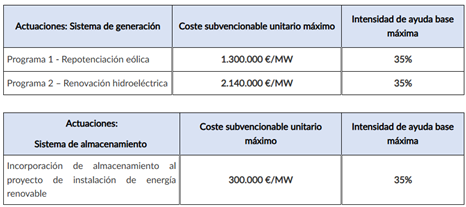
Aid in the form of a non-repayable grant, with a maximum aid intensity of up to 35% of the eligible cost.
The above aid intensities may be increased by 5 percentage points when the action is located on islands and/or in municipalities with up to 5,000 inhabitants, or non-urban municipalities with up to 20,000 inhabitants whose population centres have a population of 5,000 inhabitants or fewer, and/or in municipalities included in the Just Transition Agreements.
The total amount of aid awarded may not exceed the limit of €30 million per company and per project.
The maximum unit eligible costs and aid intensities for each of the actions are set out below:
GUARANTEES AND ADVANCE PAYMENTS
Guarantees must be provided to participate in the calls, ensuring that projects awarded aid are implemented under the terms established in the call and the regulatory bases. The amount of the guarantee will be €20,000/MW for Programme 1 and 2% of the eligible cost for Programmes 2 and 3.
Likewise, guarantees must be provided to request advance payment of the grant. Beneficiaries may request an advance, which will be considered an interim payment and will be, at most, the amount of the total aid awarded. The amount to be guaranteed will be equal to the amount of the advance plus interest calculated at the statutory interest rate, for the duration of the guarantee.
The validity period of the guarantee provided will be for a minimum duration until 2021-12-31.
SUBMISSION DEADLINE
Submission deadline: It will open at 12:00 on 15 January 2026 and close at 12:00 on 24 February 2026.
19/01/2026