IMMINENT LAUNCH OF RENOCOGEN2 TO REPLACE FOSSIL FUELS WITH RENEWABLES
The call for applications will be open from January 26 to March 2
At IMPULSO, we are pleased to inform you that the Ministry for the Ecological Transition and the Demographic Challenge (MITECO) will open, at the end of this month, the SECOND CALL for aid under the Incentive Programme for electricity and heat production projects from renewable energy sources to replace production from fossil fuels (natural gas, fuel oil or diesel), known as RENOCOGEN2.
As in the first edition, the Institute for Energy Diversification and Saving (IDAE) will be responsible for managing this aid, which will be awarded as a non-repayable grant under a competitive selection procedure
This second call has a budget of €50 million.
Below, we summarize the main characteristics of these grants:
BENEFICIARIES
Legal entities, public or private, as well as groups of legal entities, both public and private, without their own legal personality, that own a cogeneration plant or a waste treatment plant.
They must waive the specific remuneration scheme within 12 months of being notified of the aid decision, unless, as of the date of the aid decision, the regulatory useful life has been exhausted.
They must provide a declaration of absence of conflict of interest (DACI).
TYPES OF PROJECT
Eligible initiatives include plants for the production of electricity or cogeneration and/or thermal energy from renewable energy sources (biomass, biogas, geothermal, hydrothermal, aerothermal, and wind, hydroelectric and solar with storage, among other sources), either individually or as combinations of several installations, falling under the following 2 types (Annex I of the call).
- Type 1 (T-1). Electricity generation or cogeneration installations:
- Subtype 1.1 (S-1.1): electricity generation or cogeneration installations from
- Subtype 1.2 (S-1.2): electricity generation or cogeneration installations from biogas.
- Subtype 1.3 (S-1.3): electricity generation installations from wind energy with electrical storage.
- Subtype 1.4 (S-1.4): hydroelectric power plants with electrical storage.
- Subtype 1.5 (S-1.5): solar photovoltaic installations with electrical storage.
- -Type 2 (T-2). Thermal energy production installations:
- Subtype 2.1 (S-2.1): thermal energy production installations from
- Subtype 2.2 (S-2.2): thermal energy production installations from biogas.
- Subtype 2.3 (S-2.3): thermal energy production installations from geothermal or hydrothermal energy.
- Subtype 2.4 (S-2.4): thermal energy production installations from
- Subtype 2.5 (S-2.5): thermal energy production installations from solar energy with thermal storage.
A single application must be submitted for each project for which aid is sought, and it must correspond to one or more subtypes.
PROJECT REQUIREMENTS
- Actions may not begin before the date the aid application is submitted.
- The installations must be fully completed by June 30, 2029 (including any extensions).
- Minimum investment per project: €50,000.
- Location: at a maximum distance of 10 kilometres from the existing cogeneration or waste treatment plant.
- Connection to the electricity grid: for project installations under type T-1, connection to grids intended for self-consumption or otherwise is accepted.
- The nominal electrical power and nominal thermal power may be up to three times that of the existing cogeneration plant.
- In the case of electrical or thermal storage systems, they must ensure that such systems do not store, in whole or in part, electricity imported from the grid above 20% on an annual basis, and that the energy from the installation’s own systems of the renewable installation is equal to or greater than 80%.
- Where applicable, the installations carried out must comply with the requirements set out in the Low Voltage Electrical Regulation (REBT) and its supplementary technical instructions, the High Voltage Electrical Installations Regulation (RIAT) and its supplementary technical instructions, as well as any other applicable regulations, and with the requirements set out in the Regulation on Thermal Installations in Buildings (RITE).
- The installations must have a system for monitoring the energy generated by the subsidised installation with the following minimum functionalities:
- It will display the energy produced by the renewable installation on a daily, monthly and/or annual basis.
- It will display CO2 emissions avoided and the economic savings generated for the owner of the installation.
- It will include a screen in a visible location showing the above data in an updated manner; this data may also be accessible via a mobile device or web application.
- Selected projects must comply with the principle of “do no significant harm” to the environment (DNSH).
ASSESSMENT CRITERIA
They will be assessed out of a total of 100 points:
ELIGIBLE COST ITEMS
Costs related to the implementation of:
- Electricity generation and/or cogeneration plants and thermal energy production from biomass, biogas, and wind with electrical storage.
- Hydroelectric power plants with electrical storage or photovoltaic with electrical storage.
The following costs are accepted:
- Fuel preparation systems, unloading, storage and treatment.
- Main generation equipment for electricity, cogeneration and thermal energy.
- Storage systems for electrical and/or thermal energy.
- Heat recovery equipment, as well as distribution systems to consumption points.
- Electrical and control systems, hydraulic systems, pumping, instrumentation, auxiliaries, etc., associated with the installation and, in general, electromechanical equipment.
- Electrical substation, transformers, switchgear, cabinets, remote tripping and protection systems, meters, evacuation and interconnection lines for generation plants, and systems for electrical energy integration and demand management, earthing network, capacitor bank and, in general, electromechanical equipment, switchgear and electrical infrastructure up to the point of connection to the transmission or distribution grid.
- Control, remote metering, monitoring and communication systems with the control centre associated with the installation, including tests, commissioning and operational trials.
- Management systems, active control and monitoring of electricity demand from consumer installations supplied by the project receiving aid.
- Civil works: Buildings, yards, excavations, trenches and conduits, channels, weirs, piping, masonry works, necessary auxiliary installations, easement roads, access improvements, control buildings, assembly platforms, temporary installations, restoration, corrective environmental measures after the works, etc., provided that at least 70% (by weight) of the non-hazardous construction and demolition waste generated (excluding waste with EWC code 17 05 04) is prepared for reuse, recycling and recovery of other materials.
- Cost of dismantling existing installations on the site, where applicable, to carry out the project receiving aid, provided that at least 70% (by net weight) of the non-hazardous construction and demolition waste generated (excluding waste with EWC code 17 05 04) is prepared for reuse, recycling and recovery of other materials.
- Foundations or other anchoring systems.
- Transport and assembly, commissioning, quality controls and testing of the installations.
- Preparation of the detailed design.
- Works supervision.
- Coordination of Health and Safety for the works and assembly.
- Tests, studies and trials required to prepare the project and size the installation.
- *Costs for managing the aid application, not exceeding 4% of the amount of aid requested, with a maximum limit of €3,000 per file.
- *Costs for managing the supporting documentation for the completion of the actions.
- *Auditor’s report on the supporting account.
- Costs related to compliance with DNSH principle obligations.
- Other items duly justified as necessary.
*These costs may not exceed 7% of the amount of aid requested, with a limit of €10,000 per file.
Not accepted:
- Costs invoiced before the aid application.
- Non-new or previously used equipment and systems: Projects may include existing equipment that is not new, provided it does not use non-renewable fuels, but it will not be eligible for aid.
- Electricity or heat generation equipment that does not use renewable energy, even if used as backup.
- Heat pumps that do not meet the minimum required performance, or that do not certify performance. Heat pumps intended to operate as dehumidifier units.
TYPE AND INTENSITY OF AID
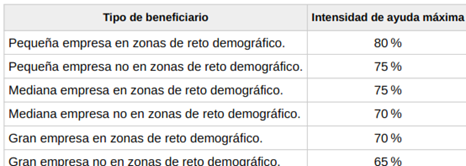
Non-repayable grant of up to 65% of the eligible cost, with SME participation assessed positively, which may receive an additional 10% aid for small enterprises and 5% for medium-sized enterprises. Likewise, the amount of aid will be increased for installations located in Demographic Challenge and Just Transition municipalities.
The maximum aid may reach €15 million per project and beneficiary.
Maximum aid intensity depending on the type of company (small, medium-sized, large) and the area where the project is located
This aid is incompatible with other aid.
GUARANTEES AND ADVANCE PAYMENTS
Guarantees of at least 10% of the aid requested by means of a bank guarantee or surety insurance. Not required in the case of beneficiaries covered by Article 42 of Royal Decree 887/2006.
Beneficiaries may receive an advance payment of up to 80% of the aid awarded; this requires a guarantee of at least the amount of the advance plus interest calculated at the statutory interest rate in force at the time the guarantee is provided.
SUBMISSION DEADLINE
Submission period: It will start at 9:00 on January 26, 2026 and end at 13:00 on March 2, 2026.
2026-01-19