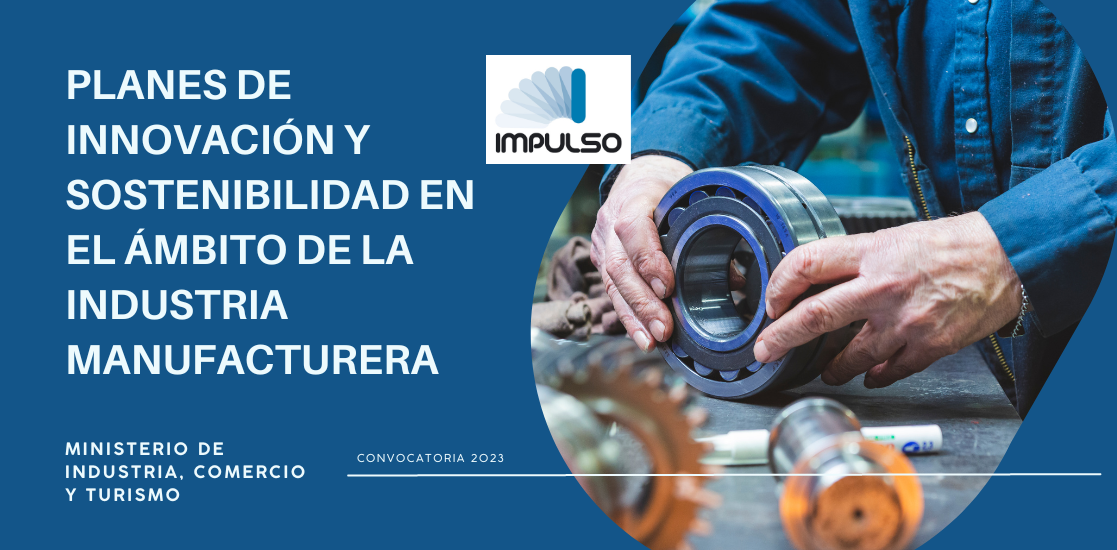
2023 CALL: INNOVATION AND SUSTAINABILITY PLANS IN THE MANUFACTURING INDUSTRY
Ministry of Industry, Trade and Tourism
At IMPULSO, we are pleased to inform you that the Ministry of Industry, Trade and Tourism has now published the 2023 call for the PROGRAMME FOR INNOVATION AND SUSTAINABILITY PLANS IN THE MANUFACTURING INDUSTRY, whose purpose is to promote innovation and sustainability plans in the manufacturing industry (industrial sector), aligned with the objectives of reactivating the overall economy and the industrial sector in particular, strengthening the resilience of the national productive sector, and aligning with the principles of climate neutrality and a circular, sustainable economy.
This call has a budget allocation of €188 million (€114 million in loans plus €74 million in grants).
Below, we summarize the main characteristics of these grants:
BENEFICIARIES
Companies with their own legal personality, incorporated in Spain and registered in the relevant register, regardless of size, that carry out an industrial activity (experience >3 years) and are not part of the public sector.
Productive industrial activity under CNAE-2009 codes 10 to 32 for at least three years. Also included (with some exceptions*) are activities classified under: section 38.3x (recovery project and having the waste management authorisation under application); CNAE 82.92*, 52.10* and 33* (activities complementary to industrial production) and CNAE 71.12 and 71.20* (industry service activities).
NOTE: this is not the CNAE code of the corporate purpose, but that of the activity carried out in the project.
PROJECT TYPES
Innovation and sustainability plans, structured into one or more projects under the following lines:
- Research, Development and Innovation line.
- Industrial research projects (aimed at acquiring new knowledge and skills that may be useful for developing new products, processes or services, or that allow significant improvement of existing ones).
- Experimental development projects (aimed at drawing up plans and arrangements or designs for new, modified or improved products, processes or services. Includes the creation of prototypes, pilot projects, testing and validation of products or processes, etc.).
- Organisational innovation projects (application of a new organisational method to business practices, workplace organisation or external relations).
- Process innovation projects (application of a new or significantly improved production or delivery method).
- Sustainability and Energy Efficiency Innovation line.
- Innovative investments aimed at environmental protection, meeting at least one of the following conditions:
- Increase the level of environmental protection by exceeding European Union standards.
- Increase the level of environmental protection in the absence of European Union standards.
- Innovative investments in energy-saving measures or renewable energy.
NOTE: Each project must fall under a single line of action. An entity may submit one or more applications.
PROJECT REQUIREMENTS
- Incentive effect.
- Minimum budget: €100,000
- Investment implementation period: from the day after the application submission date up to a maximum of 24 months from the date of the award decision.
- Guarantees: When the proposed aid combines a loan and a grant, separate proof of the establishment of guarantees must be submitted for each type of aid.
The amount of the guarantees to be provided for each type of aid will be determined based on the applicant entity’s financial rating calculated at the time of application.
| Financial Rating | Aid in the form of a grant | Aid in the form of a loan |
| Satisfactory | 80% | 20% |
| Good | 60% | 15% |
| Excellent | 40% | 10% |
- Validation report by an entity accredited by ENAC to ensure compliance with the DNSH principle: in the FINAL DECISION it will be mandatory for all projects.
- Industrial Research and Experimental Development projects: At APPLICATION stage, a report classifying the project’s R&D activities issued by an entity accredited by ENAC must be provided. Otherwise, it will be assessed as an Innovation project.
- Innovation projects in organisation and processes carried out by large companies will be checked to ensure they meet the condition of 30% collaboration with SMEs.
- Projects intended to be applied in the value chain of the manufacturing industry that fall under one of the following thematic priorities:
- Circular economy and eco-innovation to improve value chains.
- Decarbonisation, energy efficiency and new renewable energy sources, and reduction of pollutant emissions.
- Advanced materials and products.
- Innovation in industrial quality and safety processes.
- Innovations in the production process derived from developments in advanced materials and products.
ELIGIBLE COSTS
- Research, Development and Innovation line.
- Personnel costs dedicated to the project (including future hires for the project).
- Equipment and inventoried material costs: depreciation to the extent and over the period of use in the project (up to 60% of the eligible budget).
- Contract research costs, technical knowledge and patents acquired or obtained by licence from external sources under fully competitive conditions.
- Sustainability and Energy Efficiency Innovation line.
- Purchase of production machinery and equipment (difference between the investment to be made and a reference investment that is less environmentally friendly).
- Buildings and facilities (up to 50% of the eligible budget).
- Intangible assets (acquisition of patents, licences or technical knowledge).
- External collaborations (excluding management and processing of the aid).
TYPE AND INTENSITY OF AID
The aid can be in the form of a loan, grant, or a combination of both.
- Maximum amount of total financing per project (grant + nominal loan): 80% of the eligible budget.
- Loan features: Repayment term of 10 years with a 3-year grace period. Interest rate 0%.
- Limits on the nominal loan amount to be granted:
- The company’s cumulative outstanding exposure with the Directorate-General for Industry and Small and Medium-sized Enterprises < 5 times equity in the last closed financial year.
- The nominal loan amount < average turnover in the last two financial years, 2021 and 2022.
- Maximum limit of the aid to be granted in the form of a grant (limit set at €4,000,000 per corporate group):
- 50% of the eligible budget for small companies.
- 20% of the eligible budget for medium-sized companies.
- 10% of the eligible budget for large companies for Line 2 projects.
- 10% of the eligible budget for large companies for Line 1 R&D projects.
- 5% of the eligible budget for large companies for Line 1 Innovation projects.
- Maximum limits on the amount of aid granted:
- Projects predominantly involving industrial research: €20,000,000 per company and project. If it is a Eureka project or a project carried out by a joint undertaking, the limit will be €40,000,000 per company and project.
- Projects predominantly involving experimental development: €15,000,000 per company and project. If it is a Eureka project or a project carried out by a joint undertaking, the limit will be €30,000,000 per company and project.
- Innovation projects in organisation and processes: €7,500,000 per company and project.
- Environmental protection projects: €15,000,000 per company and project.
- Energy efficiency projects: €10,000,000 per company and project.
Depending on the type of project, the maximum gross aid intensity in the form of gross grant equivalent (% of the eligible budget) is as follows:
| PROJECT TYPES | NON-SME COMPANIES | MEDIUM-SIZED COMPANIES | SMALL COMPANIES AND MICROENTERPRISES |
| Industrial research | Up to 50% | Up to 60% | Up to 70% |
| Experimental development | Up to 25% | Up to 35% | Up to 45% |
| Innovation in organization and processes | Up to 15% | Up to 50% | Up to 50% |
| Environmental protection | Up to 40% | Up to 50% | Up to 60% |
| Energy efficiency | Up to 30% | Up to 40% | Up to 50% |
SUBMISSION DEADLINE
Open from May 29 to June 28, 2023.
25/05/2023