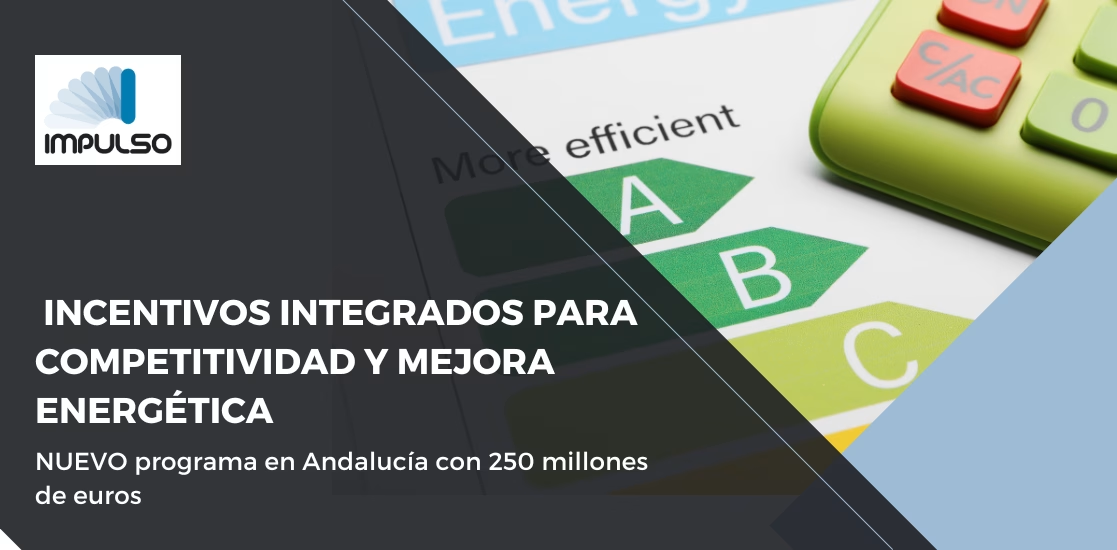
€250 MILLION FOR THE NEW INTEGRATED INCENTIVES PROGRAM FOR COMPETITIVENESS AND ENERGY IMPROVEMENT IN ANDALUSIA.
The regulatory bases for this program have been published, and the corresponding calls for applications under this program will be published shortly.
The Ministry of Industry, Energy and Mining of the Regional Government of Andalusia has published the regulatory bases for the NEW INTEGRATED INCENTIVES PROGRAM FOR COMPETITIVENESS AND ENERGY IMPROVEMENT for industrial value chains, sustainable mining and productive spaces in ANDALUSIA, and will soon begin publishing the corresponding calls for applications under this program, which has a total budget of €250 million for the 2025 calls, aimed at effectively leveraging available resources and maximizing the attraction and promotion of investment and job creation.
The general purpose of these grants is to regulate a set of integrated incentives for competitiveness and energy improvement, through 4 PROGRAMS
- Program 1. Renewable hydrogen
- Program 2. Productive spaces
- Program 3. Industrial value chains
- Program 4. Sustainable mining
These are organized into 2 INCENTIVE LINES aimed at competitive development (Line 1), through a competitive application process, and at efficient energy use in industrial value chains, sustainable mining and productive spaces in Andalusia (Line 2), through a non-competitive application process.
Below, we outline the main features of this program, pending publication of the corresponding calls for applications by line:
BENEFICIARIES:
Depending on the type of action within each line, the following may be eligible:
- Legal entities, individuals, with or without profit motive, and groupings of the above with legal personality. (Lines 1 and 2).
- Management entities for productive and business spaces, associations or homeowners’ associations established for this purpose. (Lines 1 and 2).
- Local territorial entities and local public sector entities dependent on or linked to them. (Lines 1 and 2).
- Clusters, innovative business groupings or business associations. (Line 1).
- Renewable energy communities or citizen energy communities. (Line 2).
The eligible and excluded NACE codes should be reviewed.
TYPES OF PROJECTS:
The program includes 2 separate grant lines that cover several programs. Below is a summary of the eligible actions under each:
LINE 1: Incentive line for the COMPETITIVE DEVELOPMENT of industrial value chains, sustainable mining and productive spaces in Andalusia
- Projects for the development of industrial, service-industrial and mining activities through productive investment, acquisition of consulting services, efficient use of resources and the circular economy.
- Actions and projects for the development of new products and processes, as well as to foster collaboration that strengthens and grows industrial and service-industrial value chains, and promotes sustainable mining and the use of minerals that are critical and essential for Europe.
- Business infrastructure that strengthens the SME environment, including productive and industrial spaces.
LINE 2: Incentive line for the EFFICIENT USE OF ENERGY in industrial value chains, sustainable mining and productive spaces in Andalusia,
- Projects for the energy improvement of processes and facilities and the implementation of renewable energies aimed at reducing the consumption of primary fossil energy and CO2 emissions.
- Actions and projects for the development of new sustainable energy vectors, as well as sustainable transport through hydrogen refueling and electric charging infrastructure.
- Energy storage solutions, as well as smart grids and new business models in the energy market within the areas described above.
PROJECT REQUIREMENTS:
LINE 1
- Competitive application process.
- Whose actions fall under these objectives:
- “Promotion of research and innovation activities”, under Specific Objective 1.1 “Developing and enhancing research and innovation capacities and the uptake of advanced technologies”
- “Promoting the growth, competitiveness and consolidation of SMEs” under Specific Objective 1.3 “Enhancing sustainable growth and competitiveness of SMEs and job creation in SMEs, including through productive investments”
- “Promoting the transition to a circular economy for waste” under Specific Objective 2.6 “Promoting the transition to a circular and resource-efficient economy” of the Andalusia ERDF 2021-2027 Program.
LINE 2
- Non-competitive application process.
- Whose actions fall under the following specific objectives of the Andalusia ERDF 2021-2027 Program:
- Specific Objective 2.1. “Promoting energy efficiency and reducing greenhouse gas emissions”
- Specific Objective 2.2. “Promoting the renewable energies detailed therein”
- Specific Objective 2.3. “Creating smart energy storage systems, networks and equipment outside the TEN-E”
- Specific Objective 2.8. “Promoting sustainable multimodal urban mobility, as part of the transition towards a net-zero carbon economy”.
In both lines, within these 4 PROGRAMS:
- Program 1. Renewable hydrogen
- 1.1. Production and logistics of renewable hydrogen.
- 1.2. Renewable energies for hydrogen production.
- 1.3. Hydrogen vehicle refueling infrastructure.
- Program 2. Productive spaces
- 2.1. Energy efficiency in local public sector buildings.
- 2.2. Energy efficiency in local public sector facilities.
- 2.3. Renewable energies in local public sector buildings and facilities
- 2.4. Energy efficiency in private sector buildings.
- 2.5. Energy efficiency in private sector facilities.
- 2.6. Renewable energies promoted by the private sector.
- 2.7. Smart grids and new energy market models.
- 2.8. Energy storage solutions.
- 2.2.9. Electric vehicle charging infrastructure.
- Program 3. Industrial value chains
- 3.1. Energy efficiency in buildings.
- 3.2. Energy efficiency in processes and facilities.
- 3.3. Renewable energies for buildings, processes and facilities
- 3.4. Near-market renewable technologies.
- Program 4. Sustainable mining
- 4.1. Energy efficiency in processes and facilities.
- 4.2. Renewable energies in processes and facilities.
- 4.3. Near-market renewable technologies.
ELIGIBLE COSTS
LINE 1
- Land (module: €36/m2 undeveloped and €72/m2 developed).
- Site development (module: €36/m2) Maximum 5 times the ground floor area.
- Industrial buildings and construction
- Building construction: Industrial buildings €252/m2, Cold storage facility €315/m2, Offices €303/m2.
- Fitting out or refurbishing a building: up to 75% of the module values will apply.
- Renovation: 100% of the module values apply.
- Purchase of a building: Industrial buildings €324/m2, Cold storage facility €405/m2, Offices €375/m2.
- Information and Communications Technology (ICT) infrastructure.
- Facilities not linked to a building or construction.
- Civil works required for facilities and equipment.
- Capital goods, excluding those intended for electricity production, for third parties or self-consumption.
- Facilities, including auxiliary facilities such as fire protection, security or service installations.
- Costs of instruments and materials, to the extent and for the period they are used for an innovation, industrial research, experimental development project or R&D&I project feasibility studies.
- Other investments in tangible fixed assets, not included in the above sections, that are necessary for the project.
- Intangible assets, including contractual research, knowledge, acquisition and processing of software or patents.
- Personnel costs and services provided by external personnel.
- Planning, engineering and technical direction.
- Consulting costs
- Operating expenses directly resulting from industrial research or experimental development projects.
- Cost of the activity qualification report or opinion issued by a certification body accredited by ENAC (only for expenses under the de minimis regime).
- Cost of the certification report for research and development, or innovation, projects, issued by a certification body accredited by ENAC (only for expenses under the de minimis regime).
- Feasibility study costs.
- Costs arising from construction, replacement or improvement of infrastructure.
LINE 2
- Acquisition of equipment, materials and auxiliary elements.
- Installations linked to the equipment and auxiliary elements.
- Acquisition of equipment for measuring, monitoring, controlling and managing eligible facilities and actions.
- Costs of carrying out works and/or installations directly related to the implementation of the action.
- Assembly, disassembly or demolition of existing elements.
- Planning, feasibility studies, engineering, project design, technical direction, health and safety coordination of the works, as well as the development and design of the building’s Energy Management Plan.
- Costs of external consulting services such as audits, efficiency certificates, etc.)
TYPE AND INTENSITY OF AID:
Aid is granted in the form of a non-repayable grant ranging from 40% to 70%, depending on the line of action, the program, the type of entity and the province where it is carried out.
TYPE AND INTENSITY OF AID:
Advance payments are possible.
APPLICATION PERIOD:
The application submission period will be whatever is established in the corresponding call.
If your company has a project that fits these calls for applications and you are interested in applying for funding, at IMPULSO we offer a comprehensive support service throughout the entire life of the file, from drafting the application proposal to the final justification and payment collection. Thanks to our experience, you will be able to take advantage of this great funding opportunity.
04/14/2025