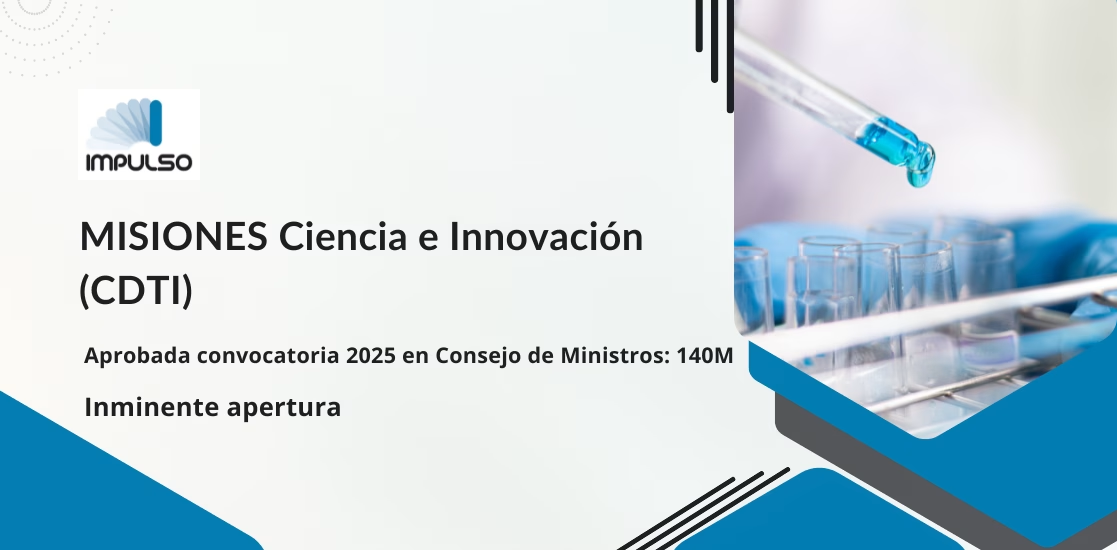
THE COUNCIL OF MINISTERS APPROVES THE AGREEMENT AUTHORIZING THE 2025 CALL FOR SCIENCE AND INNOVATION MISSIONS WORTH €140 MILLION
The 2025 MISSIONS call will open on May 29.
At yesterday’s Council of Ministers meeting, the Agreement was approved authorizing the 2025 call for aid aimed at RD SCIENCE AND INNOVATION MISSIONS PROJECTS, with a budget of €140 million (60 million, extendable by a further 80 million), which will open on May 29.
This program, run by the Ministry of Science, Innovation and Universities (MICIU) and managed through the Centre for the Development of Industrial Technology (CDTI), aims to fund collaborative RD projects led by companies, offering solutions to cross-cutting, strategic challenges facing society, addressing the socioeconomic challenges faced by developed societies.
Among the proposals for this edition are lines of work focused on security and defense, artificial intelligence, sustainable mobility and decarbonization, climate risks, and more.
This program has established itself as a great opportunity to foster research and technological development within the business sector, offering a range of advantages that can boost the growth of your projects.
Here, in advance, are the main features of this program:
BENEFICIARIES:
Business consortia made up of a minimum of 3 and up to 6 companies, where at least two are independent of each other, and at least one is an SME.
TYPES OF PROJECTS:
Collaborative business RDI projects led by companies that fall under one of the missions identified in the call, such that their objectives align with one or more of the improvement areas proposed for the mission. However, submitted projects may propose additional new objectives that complement those already defined, provided they are consistent with the selected mission.
The national challenges of the 2025 call will be:
- Competitiveness: Fostering a competitive, productive industry that generates quality employment.
- Autonomy: Promoting strategic autonomy.
- Sustainability: Promoting innovation for environmental and social sustainability.
- Inclusion and equality: Inclusive and responsible innovation.
- Demographic challenge.
The technologies and areas of action are:
| 7 Missions (technologies) | Areas of action |
| Technological solutions to reduce hospital stays and care pressure. | · Prevention and early diagnosis.
· Decentralized outpatient models. · Reduction of hospitalization |
| Responsible artificial intelligence. | · Unbiased and anonymized AI.
· Transparency and explainability. · Human oversight. · Secure AI. |
| An interconnected and secure industry that contributes to greater strategic autonomy. | · Secure connections.
· Interoperability and standardization. · Optimization of logistics and supply chain management. |
| Territorial planning and management to improve resilience and address climate risks. | · Risk prevention and analysis.
· Planning and management aimed at the smart use of land. · Increasing the resilience of buildings and transport and critical infrastructure. · Prevention and management of adverse effects arising from climate change. |
| Strategic sovereignty over raw materials essential for industry and the energy transition. | · Extraction and processing of mineral raw materials.
· Reducing the need for essential raw materials. · Circularity and reuse of essential raw materials. |
| Building capacity for strategic autonomy in security and defense. | · Information security and protection.
· Development of more efficient, lower-cost automated and remote management systems for security and defense applications. · Products and systems for aerial, land, or naval platforms with improved performance, sustainability, efficiency, and safety. · Increasing the level of protection and security of critical infrastructure. · Protection against CBRN risks. |
| Sustainable mobility and decarbonization of collective and large-volume transport in Spain. | · More efficient propulsion solutions in CyGV transport.
· Cost reduction and generation of new sustainable fuels. · Promoting efficiency and safety in the use of sustainable fuels. · Promoting smarter logistics. · Smart infrastructure and networks. |
PROJECT REQUIREMENTS:
- Duration:
- Start in 2026, lasting 3 or 4 years.
- Budget:
- Project budget: between €3.5 and 15 million.
- Subcontracting to research organizations: minimum 15% of the eligible budget.
- Subcontracting per beneficiary: < 50% of its eligible budget.
- Minimum budget per company: €175,000
- No participant may be responsible for more than 70% of the project’s eligible budget.
- Balanced distribution of the budget throughout the duration of the project.
- A minimum of 40% of activities must be industrial research.
- An internal agreement must be signed to regulate the operation of the group.
- Incentive effect. The project start date can never be earlier than the date the aid application was submitted (prior feasibility studies are excluded).
- Incompatible with any other public aid.
ELIGIBLE COSTS
- Personnel costs, for both employees under a labor contract and self-employed individuals who are company partners.
- Costs of instruments and capitalizable equipment. If not used for their entire useful life for the project, only the depreciation costs corresponding to the project’s duration will be considered eligible.
- Costs of contractual research, technical knowledge, and patents acquired or obtained under license from external sources on an arm’s-length basis (excluding those associated with project processing and management).
- Costs of materials and other additional operating expenses (materials, supplies, and other similar products arising from the project).
- Consulting activities to support the coordination work of the group’s representative (maximum: €15,000 per year).
- Travel costs linked to coordination meetings between consortium members, for employees who allocate hours to the project only (maximum €5,000/beneficiary).
- Indirect costs, calculated as 20% of direct costs (all eligible costs except audit and travel).
- Audit report expenses. Maximum €1,500 per beneficiary and per year.
AID:
Non-repayable grants ranging from 40% to 80%, depending on the size of the company and the type of project.
| Project type | Maximum aid intensity | ||
| Small Company | Medium Company | Large Company | |
| Industrial Research | |||
| Effective collaboration between companies, at least one of which is an SME, provided that no single company bears more than 70% of the eligible costs | 80% | 75% | 65% |
| Experimental development | |||
| Effective collaboration between companies, at least one of which is an SME, provided that no single company bears more than 70% of the eligible costs | 60% | 50% | 40% |
The aid intensity limit for each project and beneficiary will be a weighted average based on the budget distribution between each type of activity (industrial research or experimental development) and the maximum intensity of aid corresponding to the beneficiary and the activity.
SUBMISSION DEADLINE:
Opening date: from 05/29 to 07/01 at 12:00 PM mainland Spain time.
If your company has a project that fits this call and you are interested in applying for funding, at IMPULSO we offer a comprehensive support service throughout the entire life of the application, from the preparation of the proposal to the final justification and collection. Thanks to our experience, you will be able to take advantage of this great funding opportunity.
23/05/2025