Abierto el plazo de presentación del PROGRAMA INNOVAE -Subprograma: PROYECTOS SINGULARES DE SUSTITUCIÓN DE GENERADORES DE FRÍO
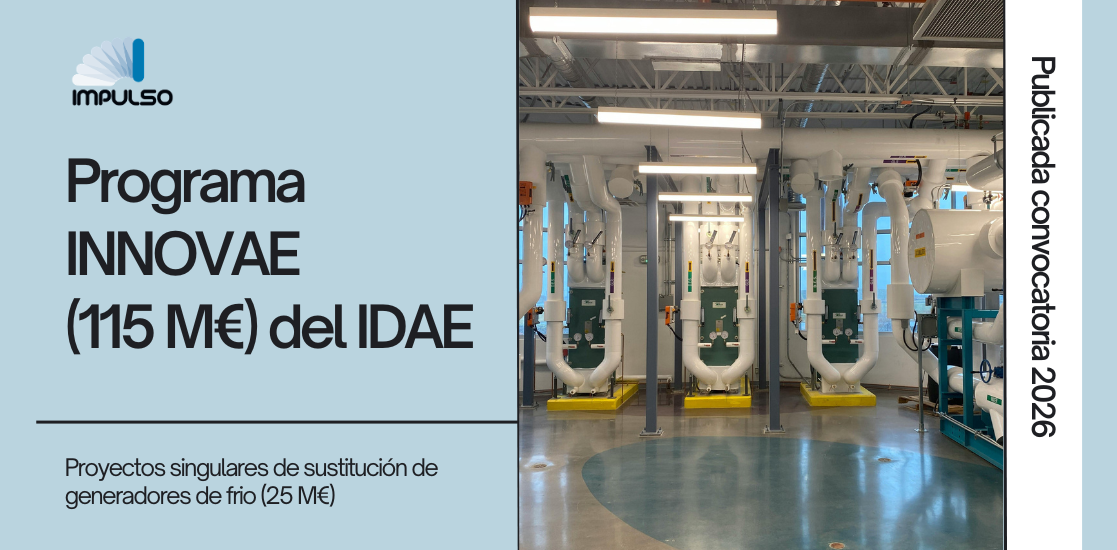
SUBPROGRAMA: Proyectos singulares de sustitución de generadores de frio, dentro del PROGRAMA DE INCENTIVOS A PROYECTOS SINGULARES INNOVADORES DE AHORRO Y EFICIENCIA ENERGÉTICA (INNOVAE).
At IMPULSO, we are pleased to inform you that IDAE has now published the 2026 call for the INCENTIVE PROGRAMME FOR INNOVATIVE FLAGSHIP ENERGY SAVING AND ENERGY EFFICIENCY PROJECTS (INNOVAE), with an initial maximum budget allocation of €115 million, aimed at promoting flagship and innovative energy saving and energy efficiency projects. The submission period for applications under this call, and the corresponding documentation, is open from 9:00 on September 15, 2026 until 12:00 on November 18, 2026.
This call represents a new opportunity for the industrial sector, especially for companies considering investments with a clear innovation component, improved energy efficiency and reduced final energy consumption.
Within the INNOVAE programme, the SUBPROGRAMME: FLAGSHIP PROJECTS FOR THE REPLACEMENT OF COOLING GENERATORS stands out in particular for the industrial sector, with a budget allocation of €25M, which seeks to promote innovative flagship projects to renovate large direct and indirect mechanical compression refrigeration systems through replacement in installations to which the Safety Regulations for Refrigeration Installations and their supplementary technical instructions apply (Royal Decree 552/2019, of 27 September).
Below is a summary of the main features of these grants:
BENEFICIARIES
- All types of companies with their own legal personality
- Individuals who carry out economic activities, offering goods and/or services on the market, in which case they must be registered in the Census of Business Owners, Professionals and Withholding Agents of the Spanish Tax Agency
- Universities and research and development centres, with their own legal personality.
- Consortia and business groupings with their own legal personality.
- The public sector referred to in Article 2 of Law 40/2015, of 1 October.
- Energy service companies.
PROJECT TYPES
ELIGIBLE ACTIONS:
- Renovation actions involving the replacement of large refrigeration systems using direct and indirect mechanical compression with new compression systems or connection to cold distribution networks.
- Only renovation projects that include the replacement of refrigeration compressors with a total installed electrical power of 100 kW or more will be eligible.
- The set of items inherent to the project to renovate refrigeration systems will also be eligible for aid, such as condensing equipment, connection to an external cold distribution network, cold distribution and emission (evaporators or air coolers), regulation, monitoring, control, remote management and facility management systems, and engineering projects. In the case of cold networks, the internal installation up to the inlet heat exchanger would be eligible.
NON-ELIGIBLE ACTIONS:
- Absorption and adsorption cooling generation installations. Air-conditioning installations intended for people’s thermal comfort, regulated by the RITE, are excluded.
- New refrigeration installations with a global warming potential (GWP) of 150 or higher.
PROJECT REQUIREMENTS
- Incentive effect.
- A competitive selection process and projects with a strong innovative character: preference will be given to the most innovative and efficient solutions.
- Minimum final energy savings of more than 20%.
- Minimum eligible cost per project: €100,000/project.
- Maximum aid per project: €2,000,000/project.
- Implementation period: from submission of the application and, at most, up to 18 months after notification of the aid award decision. Under no circumstances may extensions be authorised that, in total, exceed 24 months from the date of notification of the aid award decision.
- Allocate the assets to the specific purpose for which the grant was awarded for a period of no less than 5 years, or 3 years in the case of SMEs.
- In the event of subcontracting, provide mechanisms to ensure that subcontractors comply with the DNSH principle.
- Maintain a separate accounting system for all transactions.
ELIGIBLE COSTS
- Preparation of the detailed design project, including the necessary tests, studies and trials.
- Site supervision.
- The execution costs of the civil works, provided they do not exceed 20% of the eligible investment, and the installation assembly costs.
- The necessary equipment, services, materials and auxiliary installations, transport costs and technical assistance costs.
- Transport and assembly, commissioning, quality controls and tests.
- Health and Safety Coordination for the works and assembly.
- Costs corresponding to preparatory actions for the action related to energy efficiency, such as pre-diagnosis or energy audits. The energy audit will not be eligible if it was carried out as a result of the obligation imposed by Article 8 of Directive 2012/27/EU of the European Parliament and of the Council of 25 October 2012 on energy efficiency, as regards energy audits, accreditation of service providers and energy auditors and the promotion of energy supply efficiency, transposed by Royal Decree 56/2016 of 12 February.
- The costs of preparing and registering the energy performance certificate provided for in Royal Decree 390/2021 of 1 June, which approves the basic procedure for the certification of the energy performance of buildings.
- The costs of managing the aid application, understood as those expenses that the applicant may pay to a company or professional to carry out the administrative and documentary management of their application. Maximum €20,000 excluding VAT
- The costs of managing the justification of the completion of the actions. These will correspond to the expenses that the aid beneficiary may pay to companies or professionals to carry out the technical, administrative and documentary management of the justification of the completion of the actions . Maximum €20,000 excluding VAT.
- Cost arising from the preparation of the auditor’s report on the supporting account . Maximum €10,000 excluding VAT.
- Cost arising from the preparation of the auditor’s report relating to compliance with Article 13.3 bis of Law 38/2003, of 17 November . Maximum €10,000 excluding VAT.
Please note:
- A minimum of 3 quotes must be provided in the justification when the works amount exceeds €40,000 and the goods or services exceed €15,000, or already at the time of the aid application.
- The physical equipment associated with the eligible budget must bear the corresponding CE marking or declaration of conformity and serial number.
- For the costs of external collaborations, consultancy or engineering, the tasks carried out by the same supplier may not be split.
- Expenses relating to the leasing of tangible assets, including finance leasing, will not be included as eligible costs. Only the costs of production apparatus and equipment that are the subject of a finance lease agreement will be considered eligible, if the beneficiary expressly assumes the obligation to acquire them at the end of that agreement.
- Subcontracting:
- It may reach up to a maximum of 50% of the incentivised activity.
- Under no circumstances may the expense corresponding to the same purpose and the same supplier be split, nor may a contract be split in order to reduce its amount.
- Comply with the principle of “do no significant harm to the environment” (DNSH).
- When it exceeds 20% of the grant amount and that amount is greater than €60,000, it must:
- Enter into a written contract.
- Request prior and express authorisation from the awarding body; authorisation must be requested in advance of the contract signing date and the start of the work. The request must be accompanied by a report justifying the need for subcontracting.
- At the time of justification, a certificate signed by each contracted subcontractor must be provided, stating:
- That they are not subject to any of the prohibitions in Article 13 of Law 38/2003, of 17 November.
- Whether they have received other grants for carrying out the activity subject to the contract.
- Whether they are advisers or intermediaries where payments are defined as a % of the total cost of the operation.
- Whether they are individuals or entities applying for aid or a grant under the same call and programme.
- Commitment to comply with the duty to cooperate.
- Whether they are individuals or entities linked to the beneficiary.
- Commitment not to cause significant harm to the environment (DNSH).
- In cases where prior authorisation is required to carry out subcontracting, the beneficiary must provide the above statements by means of a responsible declaration signed by the subcontractors.
- Subcontracting with related parties:
- Justification report on the need for subcontracting to achieve the objectives of the aided action.
- The amount of the aid must not exceed the cost incurred by the related entity.
- Attach at least three quotes.
- Excluded costs:
- Costs invoiced to the aid beneficiary prior to the registration date of the requested aid application, except for costs corresponding to preparatory actions related to energy efficiency.
- Equipment and systems that are not new or that have been previously used, unless otherwise provided for in the corresponding call.
- Installation or replacement of heat generators with others powered by fossil fuels (diesel, natural gas, propane, butane, etc.).
- Operating costs, such as preventive and corrective maintenance, etc.
- Indirect taxes, Value Added Tax (VAT) or, where applicable, Canary Islands General Indirect Tax (IGIC) or the Tax on Production, Services and Imports (IPSI) borne, except where the grant beneficiary actually pays them, in accordance with Article 31.8 of Law 38/2003, of 17 November. Under no circumstances are indirect taxes considered eligible costs when they are recoverable or offsettable, nor are personal income taxes.
- Environmental impact studies and costs for the official endorsement of technical projects.
- Any other promotional costs incurred by the applicant to develop the project.
- Administrative authorisations, licences, permits, guarantee and/or bond costs, fines, fees and/or taxes.
- Any costs associated with administrative management, contracting, enquiries or procedures, even if necessary to obtain permits or licences, that are not included above.
- Cost of purchasing or leasing buildings or land used for the project.
- Insurance policies taken out by the applicant.
- Surveillance and security during the execution of the works until the commissioning date.
- Adaptation of access on public roads and existing paths up to the installation.
- Acquisition of companies.
- Any financial costs.
- Under no circumstances will late-payment interest and compensation for collection costs due to non-compliance with the payment deadlines set out in Law 3/2004, of 29 December, be considered eligible costs.
- Permanent staff costs linked by statute or employment relationship to public research bodies, public universities and, in general, bodies whose budgets are consolidated in the State General Budget (PGE) or those of the autonomous communities, as well as other costs already covered by the allocations provided for in the State General Budget Law or in the budget laws of the autonomous communities, will not be considered eligible.
- Installations that do not provide or are not linked to achieving the programme objective of final energy savings.
TYPE AND INTENSITY OF AID
- Aid in the form of a non-repayable grant.
- The aid percentage will be applied to the eligible cost, not necessarily to the project’s total investment. The eligible cost will be calculated as the difference between the eligible cost of the action and the amount of the reference investment. The reference investment corresponds to a viable counterfactual scenario that does not incorporate the energy efficiency improvement covered by the aid.
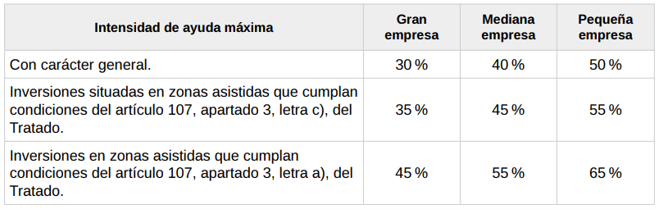
- If the applicant does not carry out an economic activity, the maximum aid intensity will be 70%.
- The same applicant may submit more than one action. The aid to be awarded may not exceed the aid limit per project and beneficiary.
SUBMISSION PERIOD
From 9:00 on 2026-09-15 until 12:00 on 2026-11-18.
21/07/2026